

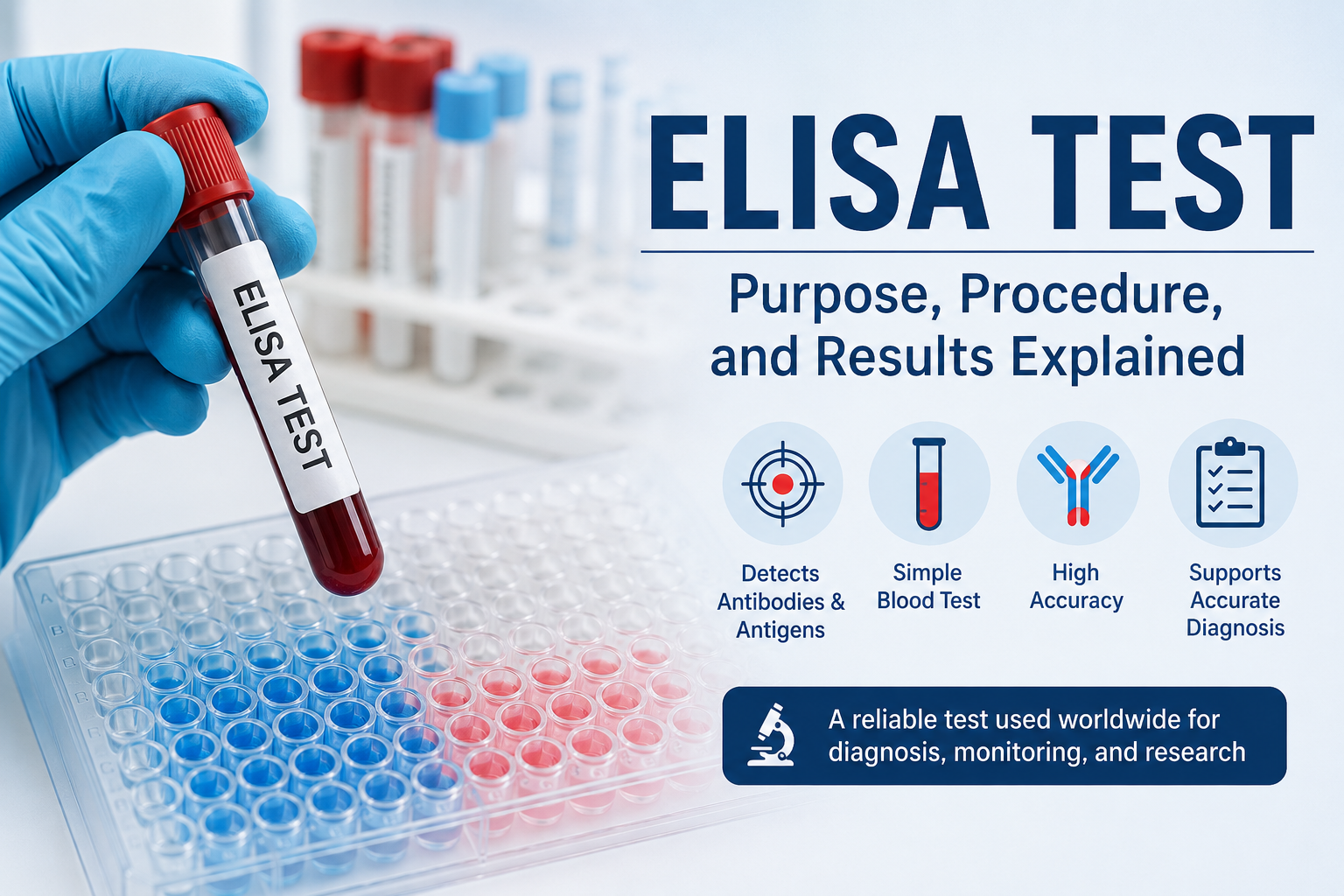
Elisa Test: Purpose, Procedure, and Results Explained
The Elisa Test is one of the most widely used laboratory tests for detecting antibodies, antigens, proteins, and hormones in blood and other biological samples. Doctors and researchers rely on this test because it is accurate, sensitive, and capable of identifying many infectious diseases and medical conditions at an early stage.
Whether you’ve been advised to take an Elisa Test, are studying laboratory medicine, or simply want to understand how this diagnostic method works, knowing the basics can help you interpret the process and results with greater confidence.
This guide explains the purpose of the Elisa Test, how it is performed, what the results mean, its advantages and limitations, and the conditions it helps diagnose.
Key Takeaways
- The Elisa Test detects antibodies, antigens, proteins, and hormones in blood or other body fluids.
- It is commonly used to diagnose infections, autoimmune diseases, allergies, and certain hormonal disorders.
- The test is highly sensitive and reliable but sometimes requires confirmatory testing.
- Results can be positive, negative, or inconclusive depending on the detected substance.
- Proper interpretation should always consider symptoms, medical history, and additional laboratory findings.
Main Article
What Is an Elisa Test?
The Enzyme-Linked Immunosorbent Assay (ELISA), commonly known as the Elisa Test, is a laboratory technique designed to detect and measure specific molecules in a sample.
These molecules may include:
- Antibodies
- Antigens
- Proteins
- Hormones
- Peptides
The test works by using enzymes attached to antibodies that produce a measurable color change when the target substance is present.
Because of its high sensitivity and specificity, the Elisa Test has become a standard diagnostic tool in hospitals, research laboratories, blood banks, and public health facilities worldwide.
Purpose of an Elisa Test
Healthcare professionals order an Elisa Test for several reasons.
Its primary purposes include:
- Detecting infectious diseases
- Identifying immune responses
- Measuring hormone levels
- Diagnosing autoimmune disorders
- Detecting allergens
- Monitoring treatment effectiveness
- Supporting medical research
The test provides valuable information that helps physicians make accurate diagnoses and treatment decisions.
Conditions Diagnosed Using an Elisa Test
The Elisa Test is used in many medical specialties.
Infectious Diseases
It can help detect infections caused by viruses, bacteria, fungi, and parasites.
Common examples include:
- HIV
- Hepatitis B
- Hepatitis C
- Lyme disease
- COVID-19 antibody testing
- Dengue fever
- Syphilis
- Helicobacter pylori infection
Autoimmune Diseases
The test can identify antibodies associated with autoimmune conditions such as:
- Lupus
- Rheumatoid arthritis
- Celiac disease
- Hashimoto’s thyroiditis
Allergy Testing
Doctors may use the Elisa Test to detect allergy-related antibodies against:
- Foods
- Pollens
- Animal dander
- Dust mites
- Insect venom
Hormone Testing
Certain hormone levels can also be measured, including:
- Human chorionic gonadotropin (hCG)
- Insulin
- Thyroid-related hormones
- Cortisol
Cancer Research
Although it is generally not used alone to diagnose cancer, the Elisa Test may help detect tumor markers and monitor disease progression in some cases.
How Does an Elisa Test Work?
The Elisa Test is based on a simple but highly effective immunological principle.
Step 1: Sample Collection
A healthcare provider collects a blood sample from a vein. In some cases, saliva, urine, or other body fluids may also be used.
Step 2: Sample Preparation
The sample is placed into a laboratory plate containing specific antigens or antibodies.
Step 3: Binding Reaction
If the target substance is present, it binds to the matching antibody or antigen.
Step 4: Enzyme Reaction
An enzyme-linked antibody is added.
When the appropriate chemical solution is introduced, the enzyme creates a color change.
Step 5: Measuring Results
Laboratory equipment measures the color intensity.
A stronger color usually indicates a higher concentration of the target molecule.
Types of Elisa Tests
Several versions of the Elisa Test exist depending on the testing objective.
| Type | Main Purpose |
|---|---|
| Direct ELISA | Detects antigens directly |
| Indirect ELISA | Detects antibodies |
| Sandwich ELISA | Measures proteins and antigens with high accuracy |
| Competitive ELISA | Measures small molecules and hormone concentrations |
Each type has unique strengths depending on the laboratory application.
Preparing for an Elisa Test
Preparation depends on the condition being investigated.
General recommendations include:
- Follow your doctor’s instructions carefully.
- Inform your healthcare provider about medications and supplements.
- Mention any recent vaccinations or infections.
- Fasting is usually unnecessary unless another blood test requires it.
- Stay well hydrated before your blood draw.
Most people require no special preparation.
What Happens During the Procedure?
The procedure is quick and straightforward.
- A healthcare professional cleans the skin.
- A needle is inserted into a vein.
- Blood is collected into a test tube.
- The needle is removed.
- Pressure is applied to stop bleeding.
The blood collection usually takes less than five minutes.
The laboratory analysis may take several hours to several days depending on the facility.
Understanding Elisa Test Results
Results should always be interpreted by a qualified healthcare provider.
Negative Result
A negative result generally means the target antibody or antigen was not detected.
Possible reasons include:
- No infection
- Testing too early
- Levels below the detection limit
Positive Result
A positive result indicates that the target substance has been detected.
However, a positive result does not always confirm an active disease.
Doctors often consider:
- Symptoms
- Physical examination
- Medical history
- Additional laboratory tests
Indeterminate or Borderline Result
Sometimes results are unclear.
In these situations, doctors may recommend:
- Repeat testing
- Confirmatory testing
- Follow-up blood work
Elisa Test vs PCR Test
Although both tests help diagnose diseases, they serve different purposes.
| Feature | Elisa Test | PCR Test |
|---|---|---|
| Detects | Antibodies or antigens | Genetic material (DNA or RNA) |
| Purpose | Immune response or proteins | Active infection |
| Sample | Usually blood | Swab, blood, saliva, or other samples |
| Best For | Past exposure, immune response | Current infection |
| Technology | Immunological assay | Molecular biology |
Doctors often use both tests together for a more complete clinical picture.
Advantages of the Elisa Test
The Elisa Test offers several important benefits.
- High sensitivity
- High specificity
- Cost-effective
- Relatively quick
- Suitable for screening large populations
- Can process many samples simultaneously
- Reliable for routine laboratory testing
These strengths explain why it remains one of the most widely used diagnostic methods worldwide.
Limitations of the Elisa Test
Like every medical test, the Elisa Test has limitations.
These include:
- Possible false-positive results
- Possible false-negative results
- Results may vary depending on timing
- Some diseases require confirmatory testing
- Interpretation depends on clinical context
A laboratory result should never be interpreted in isolation.
Risks of an Elisa Test
The Elisa Test itself is considered very safe.
Minor risks associated with blood collection include:
- Mild pain
- Small bruise
- Temporary dizziness
- Rare infection at the needle site
Serious complications are extremely uncommon.
Factors That Can Affect Results
Several factors may influence the accuracy of an Elisa Test.
Examples include:
- Testing too early after infection
- Recent vaccinations
- Certain medications
- Autoimmune diseases
- Laboratory handling errors
- Poor sample quality
Following your healthcare provider’s instructions helps reduce the chance of inaccurate results.
Who May Need an Elisa Test?
Doctors may recommend an Elisa Test for people who:
- Have symptoms of an infection
- Have been exposed to an infectious disease
- Need allergy testing
- Are being evaluated for autoimmune disease
- Require hormone testing
- Are donating blood
- Need follow-up after treatment
- Participate in clinical research
When Should You Contact a Doctor?
You should discuss your results with a healthcare provider if:
- You receive a positive result.
- Symptoms continue despite a negative result.
- Your symptoms worsen.
- You have repeated inconclusive results.
- You have questions about follow-up testing.
Prompt medical advice ensures appropriate diagnosis and treatment.
Frequently Asked Questions
1. What does an Elisa Test detect?
An Elisa Test detects antibodies, antigens, proteins, hormones, or other specific biological substances depending on the purpose of the test.
2. Is an Elisa Test painful?
The laboratory test itself is not painful. You may only experience mild discomfort during the blood draw.
3. How accurate is an Elisa Test?
The Elisa Test is highly accurate when performed correctly, but no diagnostic test is 100% perfect. Results are interpreted alongside clinical findings.
4. How long does it take to receive Elisa Test results?
Results may be available within a few hours or may take several days depending on the laboratory and the type of analysis performed.
5. Can an Elisa Test detect HIV?
Yes. The Elisa Test is widely used as an initial screening test for HIV. Positive results are usually confirmed with additional testing.
6. Do I need to fast before an Elisa Test?
Most Elisa Tests do not require fasting unless your healthcare provider requests additional blood tests that do.
7. Can an Elisa Test produce false results?
Yes. Both false-positive and false-negative results are possible, although they are relatively uncommon. Timing and medical history can affect accuracy.
Conclusion
The Elisa Test is one of the most valuable diagnostic tools in modern medicine. Its ability to detect antibodies, antigens, proteins, and hormones makes it useful for diagnosing infectious diseases, autoimmune disorders, allergies, and many other health conditions. The procedure is simple, safe, and highly reliable when performed and interpreted correctly.
While the Elisa Test provides important diagnostic information, no laboratory result should be viewed in isolation. Healthcare providers consider your symptoms, medical history, physical examination, and additional tests before making a diagnosis. Understanding how the Elisa Test works and what its results mean can help you take a more informed role in managing your health and discussing your care with your medical team.





Leave a Reply