

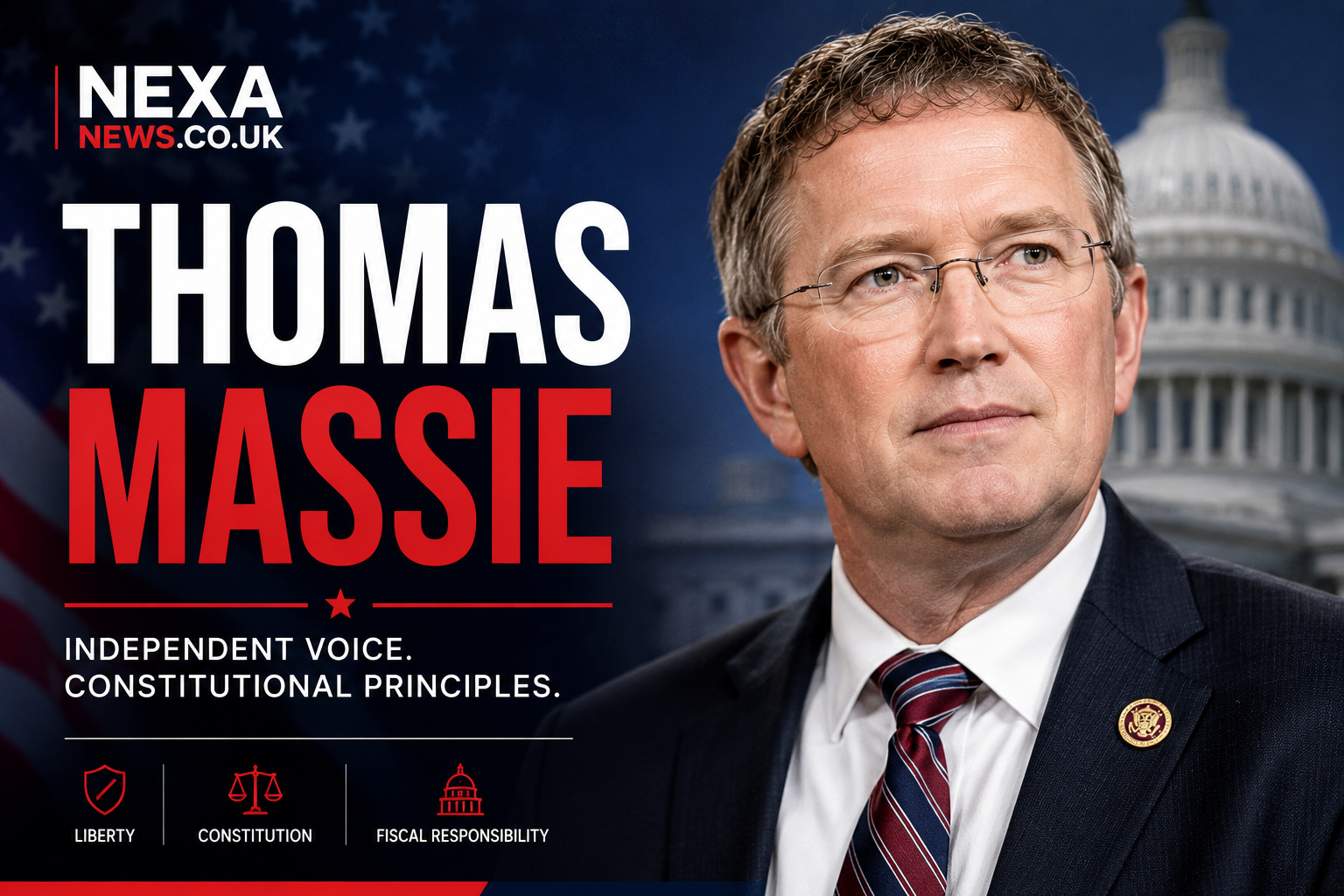
What Does Thomas Massie Stand For? Policy Positions Explained
Thomas Massie has earned a reputation as one of the most independent and consistently principled members of the U.S. House of Representatives. While he is a Republican, his voting record often sets him apart from both his own party and Democrats. Supporters praise him for adhering closely to constitutional principles and limited government, while critics argue that some of his positions are too uncompromising.
If you’ve ever wondered what Thomas Massie stands for, this guide explains his core political philosophy, major policy positions, and how those beliefs influence his voting record. Whether you’re researching his career, following American politics, or preparing to vote, understanding his views provides valuable insight into one of Congress’s most distinctive lawmakers.
Key Takeaways
- Thomas Massie is a constitutional conservative and libertarian-leaning Republican.
- He consistently supports limited government, lower taxes, and reduced federal spending.
- He strongly defends the Second Amendment, individual privacy, and civil liberties.
- Massie often opposes foreign military intervention and favors a restrained foreign policy.
- His voting record frequently reflects constitutional principles, even when it means breaking with his own party.
Biography Table
| Field | Information |
|---|---|
| Full Name | Thomas Harold Massie |
| Date of Birth | January 13, 1971 |
| Age | 55 (as of 2026) |
| Birthplace | Huntington, West Virginia, United States |
| Nationality | American |
| Profession | Politician, Engineer |
| Education | Massachusetts Institute of Technology (MIT), B.S. and M.S. in Mechanical Engineering |
| Years Active | 2010–Present (public office) |
| Known For | U.S. Representative for Kentucky’s 4th Congressional District, constitutional conservatism, libertarian-leaning voting record |
| Major Achievements | Elected to Congress in 2012; recognized for consistent constitutional voting and fiscal conservatism |
| Estimated Net Worth (Approximate, if publicly reported) | Public estimates vary; no widely verified figure is available. |
Main Article
Who Is Thomas Massie?
Thomas Massie represents Kentucky’s 4th Congressional District in the U.S. House of Representatives. Before entering politics, he built a successful career as an engineer and entrepreneur after graduating from the Massachusetts Institute of Technology (MIT).
Massie first gained public attention as Judge-Executive of Lewis County, Kentucky, where he emphasized efficient government and fiscal responsibility. Since joining Congress in 2012, he has developed a reputation for carefully reading legislation and voting according to his interpretation of the U.S. Constitution rather than party expectations.
His philosophy combines traditional conservative values with many libertarian principles, especially regarding personal freedom and limiting federal power.
Thomas Massie’s Core Political Philosophy
At the center of Thomas Massie’s political beliefs is the idea that the federal government should exercise only the powers specifically granted by the Constitution.
His philosophy rests on several key principles:
- Limited federal government
- Individual liberty
- Constitutional originalism
- Fiscal responsibility
- Protection of civil liberties
- Free-market economics
- State and local decision-making
Rather than supporting government expansion, Massie generally argues that individuals, families, businesses, and state governments should have greater authority over many issues.
Limited Government and Constitutional Conservatism
One of Massie’s defining characteristics is his commitment to constitutional conservatism.
He frequently asks whether proposed legislation is authorized under the Constitution before deciding whether to support it.
This approach often leads him to oppose bills that receive overwhelming bipartisan support if he believes they exceed constitutional limits.
Supporters view this consistency as evidence of principle. Critics argue that it can make compromise more difficult on complex national issues.
Fiscal Policy: Lower Spending and Smaller Government
Reducing Federal Spending
Massie has consistently advocated for reducing federal expenditures and controlling the national debt.
His fiscal priorities include:
- Cutting unnecessary government programs
- Reducing annual budget deficits
- Limiting government borrowing
- Opposing excessive federal spending packages
He has frequently voted against large spending bills introduced by both Republican and Democratic administrations when he believed they increased government spending beyond sustainable levels.
Tax Policy
Massie generally supports:
- Lower taxes
- Simpler tax laws
- Reduced regulatory burdens
- Policies encouraging private-sector investment
He argues that lower taxation allows individuals and businesses to make better economic decisions than centralized government planning.
Gun Rights and the Second Amendment
Perhaps no issue is more closely associated with Thomas Massie than his strong support for gun rights.
He believes the Second Amendment protects an individual’s right to own firearms and generally opposes new federal gun restrictions.
His positions often include support for:
- Constitutional carry
- National reciprocity for concealed carry permits
- Protecting lawful gun ownership
- Limiting federal firearm regulations
Massie has also introduced and supported legislation intended to expand protections for lawful gun owners.
Supporters argue these positions uphold constitutional freedoms, while opponents contend they may limit efforts to reduce gun violence.
Healthcare Policy
Thomas Massie generally favors market-based healthcare reforms over expanded federal involvement.
His healthcare philosophy includes:
- Greater competition among insurers
- Increased patient choice
- Reduced federal regulation
- Opposition to government-run healthcare systems
He has been a consistent critic of the Affordable Care Act, arguing that healthcare decisions should be driven more by patients and providers than by federal mandates.
Federal Spending and Government Debt
Massie frequently raises concerns about the size of the U.S. national debt.
He argues that persistent federal deficits threaten long-term economic stability by increasing interest costs and placing financial burdens on future generations.
As a result, he has often opposed:
- Large emergency spending bills
- Omnibus appropriations
- Expansive federal stimulus packages
- Budget measures that substantially increase borrowing
Even when such legislation enjoys broad bipartisan support, Massie has often maintained his opposition based on fiscal principles.
Privacy and Civil Liberties
Privacy rights represent another major component of Massie’s platform.
He has expressed concern about excessive government surveillance and supports stronger protections for individual privacy.
His positions generally include:
- Limiting warrantless surveillance
- Strengthening Fourth Amendment protections
- Defending encryption
- Restricting unnecessary collection of personal data by government agencies
These views often align him with civil liberties advocates across the political spectrum.
Foreign Policy
Thomas Massie generally supports a restrained approach to foreign policy.
He has often questioned long-term military engagements overseas and believes Congress should play a greater constitutional role in authorizing military action.
His foreign policy priorities include:
- Avoiding unnecessary military intervention
- Greater congressional oversight of military operations
- Careful evaluation of foreign aid
- Prioritizing U.S. national interests
This approach sometimes places him outside the mainstream positions of both major political parties.
Energy and Environmental Policy
Massie supports domestic energy production while expressing skepticism toward extensive federal environmental regulation.
His positions typically include:
- Expanding domestic energy resources
- Reducing regulatory burdens
- Encouraging technological innovation
- Allowing markets to influence energy development
Rather than favoring large federal climate initiatives, he generally advocates market-driven solutions and innovation.
Agriculture and Rural America
Representing a largely rural Kentucky district has influenced many of Massie’s policy priorities.
He frequently supports:
- Property rights
- Agricultural producers
- Reduced federal regulations affecting farmers
- Local decision-making for rural communities
He argues that federal policies should recognize the unique needs of rural economies.
Immigration
Massie supports stronger border security and enforcement of existing immigration laws.
His positions generally include:
- Enhanced border security
- Enforcement of immigration laws
- Opposition to broad amnesty proposals
- Merit-based legal immigration reforms
Like many of his policy positions, he frames immigration primarily as an issue of constitutional governance and national sovereignty.
Education Policy
Massie believes education decisions should primarily be made at the state and local levels rather than by the federal government.
His education priorities include:
- Local control of schools
- Greater parental involvement
- Reduced federal mandates
- Educational choice initiatives
He argues that communities are better positioned than Washington to determine educational priorities.
Technology and Innovation
With his engineering background, Massie often approaches technology policy differently than many lawmakers.
He has shown interest in:
- Innovation
- Digital privacy
- Patent issues
- Technology entrepreneurship
His technical expertise has informed discussions on cybersecurity, digital infrastructure, and emerging technologies.
How Thomas Massie Differs From Other Republicans
Although Massie is a Republican, he frequently votes independently.
Some notable characteristics include:
| Issue | Thomas Massie’s General Position |
|---|---|
| Federal Spending | Consistently favors reductions |
| Government Size | Strongly supports limiting federal authority |
| Gun Rights | Among Congress’s strongest Second Amendment advocates |
| Privacy | Supports expanded civil liberties protections |
| Foreign Policy | Prefers limited military intervention |
| Constitution | Places constitutional interpretation at the center of legislative decisions |
His willingness to oppose party leadership has contributed to his reputation as one of Congress’s most independent members.
Supporters’ Perspective
Supporters often admire Thomas Massie because they believe he:
- Votes consistently rather than politically.
- Defends constitutional principles.
- Protects individual freedoms.
- Challenges government expansion.
- Demonstrates fiscal discipline.
Many see him as a lawmaker who prioritizes principles over political convenience.
Critics’ Perspective
Critics argue that Massie’s approach can be too rigid.
Common criticisms include:
- Opposition to bipartisan spending measures.
- Resistance to expanded federal programs.
- Limited support for broader gun regulations.
- Strict constitutional interpretation that may restrict legislative flexibility.
Even critics, however, often acknowledge that his voting record reflects a high degree of consistency.
Overall Political Identity
Thomas Massie is often described as a constitutional conservative with libertarian influences.
Rather than emphasizing party loyalty, he generally frames policy decisions around individual liberty, limited government, fiscal restraint, and constitutional interpretation.
This consistent philosophy explains why he sometimes votes alongside Republican leadership, occasionally aligns with civil liberties advocates from across the political spectrum, and at other times stands almost entirely alone.
Frequently Asked Questions
1. Is Thomas Massie a conservative?
Yes. Thomas Massie is widely considered a constitutional conservative with significant libertarian influences, particularly regarding limited government and individual liberty.
2. What political party does Thomas Massie belong to?
He is a member of the Republican Party and has represented Kentucky’s 4th Congressional District since 2012.
3. What is Thomas Massie best known for?
He is best known for his strong support of the U.S. Constitution, fiscal conservatism, gun rights, limited government, and independent voting record.
4. Does Thomas Massie support the Second Amendment?
Yes. He is one of the strongest advocates for Second Amendment protections in Congress and generally opposes new federal firearm restrictions.
5. What are Thomas Massie’s economic views?
He supports lower taxes, reduced federal spending, free-market policies, balanced budgets, and limiting the size and scope of the federal government.
6. What is Thomas Massie’s foreign policy approach?
Massie generally favors a restrained foreign policy, emphasizing congressional authority over military action and caution toward prolonged overseas interventions.
7. Why does Thomas Massie sometimes vote against his own party?
He often says his votes are guided by his interpretation of the Constitution rather than party leadership or political strategy, leading him to oppose legislation from both Republicans and Democrats.
Conclusion
Thomas Massie has established himself as one of the most ideologically consistent members of Congress. His positions are rooted in constitutional conservatism, limited government, individual liberty, fiscal responsibility, and a strong commitment to protecting civil liberties. These principles shape his views on taxation, healthcare, gun rights, federal spending, privacy, immigration, and foreign policy.
Whether readers agree or disagree with his conclusions, understanding what Thomas Massie stands for requires looking beyond party labels. His legislative record reflects a long-standing emphasis on constitutional interpretation and limited federal authority, making him a distinctive voice in American politics and an influential figure within the broader conservative movement.











Leave a Reply