

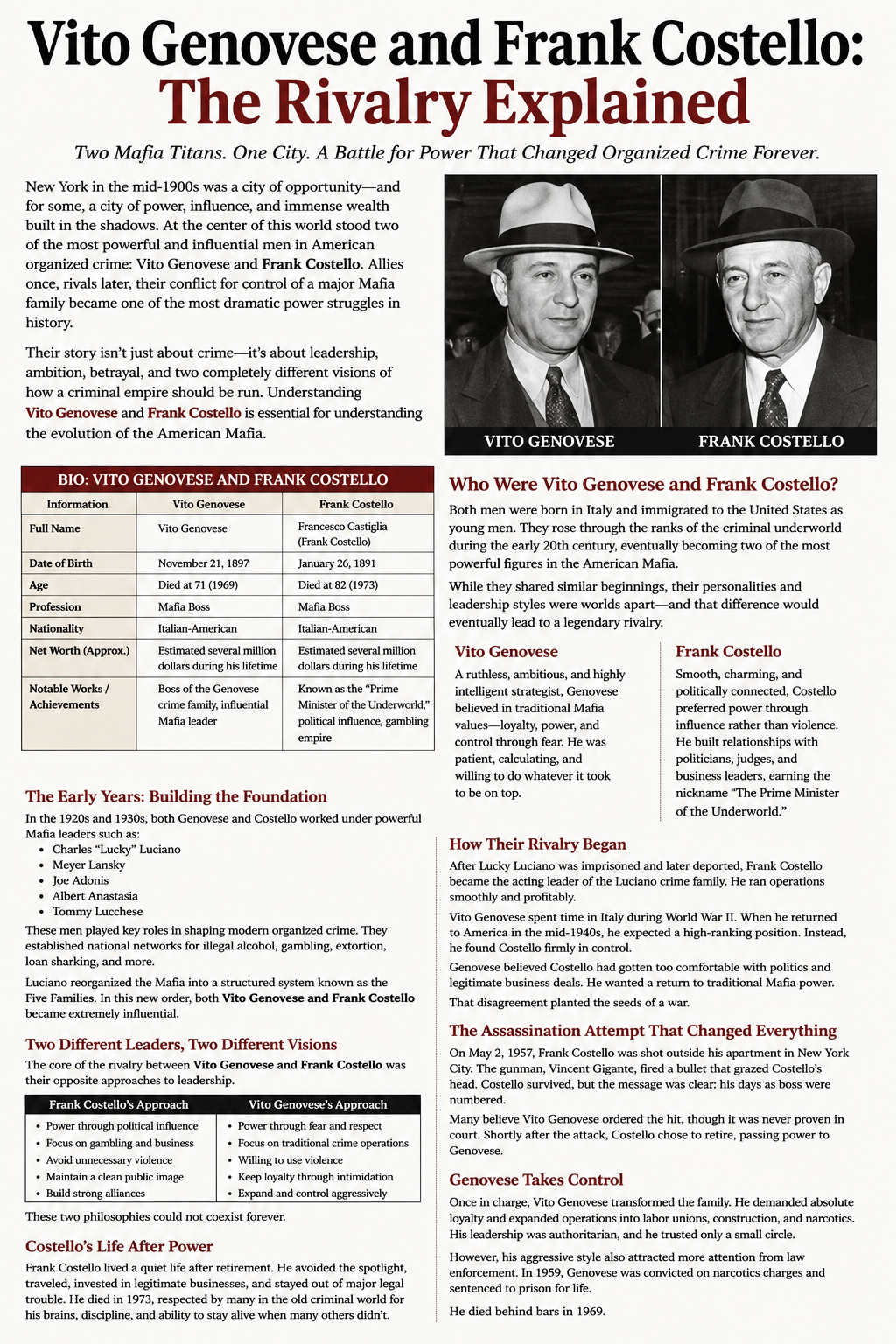
Vito Genovese and Frank Costello: The Rivalry Explained
The history of organized crime in America is filled with powerful personalities, shifting alliances, and dramatic betrayals. Yet few rivalries have captured as much attention as Vito Genovese and Frank Costello. Their battle for control of one of New York’s most influential Mafia families became a turning point in the history of the American underworld.
While Hollywood has often portrayed mobsters as glamorous figures, the real story is far more complex. Behind the expensive suits, luxurious lifestyles, and political connections stood ruthless ambition and constant struggles for power. The conflict between Vito Genovese and Frank Costello perfectly illustrates how trust could disappear overnight and how leadership within the Mafia often depended on fear as much as respect.
This article explores their backgrounds, rise to power, leadership styles, rivalry, lasting legacy, and the impact they had on organized crime in the United States.
BIO: Vito Genovese and Frank Costello
| Information | Vito Genovese | Frank Costello |
|---|---|---|
| Full Name | Vito Genovese | Francesco Castiglia (Frank Costello) |
| Date of Birth | November 21, 1897 | January 26, 1891 |
| Age | Died at 71 (1969) | Died at 82 (1973) |
| Profession | Mafia Boss | Mafia Boss |
| Nationality | Italian-American | Italian-American |
| Net Worth (Approx.) | Estimated several million dollars during his lifetime | Estimated several million dollars during his lifetime |
| Notable Works / Achievements | Boss of the Genovese crime family, influential Mafia leader | Known as the “Prime Minister of the Underworld,” political influence, gambling empire |
Who Were Vito Genovese and Frank Costello?
Understanding Vito Genovese and Frank Costello requires looking beyond crime headlines. Both men were immigrants from Italy who became central figures in the development of organized crime during the early twentieth century.
Although they shared similar beginnings, their personalities and leadership styles could not have been more different. That difference eventually created one of the most famous power struggles in Mafia history.
Vito Genovese
Vito Genovese arrived in the United States as a child and quickly became involved with New York’s criminal underworld. His reputation grew through bootlegging, extortion, racketeering, and violent enforcement during the Prohibition era.
Genovese believed that absolute power required aggressive action. He had little patience for compromise and preferred intimidation over negotiation.
Frank Costello
Frank Costello also immigrated from Italy but developed a very different reputation. Rather than relying primarily on violence, Costello focused on business, political influence, gambling operations, and strategic relationships.
He earned the nickname “Prime Minister of the Underworld” because of his remarkable ability to work with politicians, judges, business leaders, and law enforcement contacts.
Early Mafia Connections
During the 1920s and early 1930s, both men worked alongside influential gangsters such as:
- Charles “Lucky” Luciano
- Meyer Lansky
- Joe Adonis
- Albert Anastasia
- Tommy Lucchese
This generation transformed traditional Mafia operations into sophisticated criminal organizations.
Instead of neighborhood gangs competing endlessly, they built national crime networks focused on cooperation and profit.
The Luciano Crime Family
One of the most important developments in American organized crime was the formation of the modern Five Families in New York.
Lucky Luciano reorganized the Mafia after the Castellammarese War, creating a more structured system.
Under this arrangement:
- Frank Costello became one of Luciano’s closest allies.
- Vito Genovese served as an ambitious and influential lieutenant.
- Both gained tremendous experience managing criminal enterprises.
However, beneath the surface, competition continued to grow.
Different Leadership Styles
The rivalry between Vito Genovese and Frank Costello was not simply personal.
It reflected two completely different visions of Mafia leadership.
Frank Costello’s Approach
Costello believed stability created profits.
His priorities included:
- Political corruption
- Illegal gambling
- Business investments
- Public influence
- Avoiding unnecessary violence
He understood that excessive bloodshed attracted government attention.
Vito Genovese’s Strategy
Genovese valued strength above diplomacy.
His leadership focused on:
- Fear
- Loyalty
- Ruthless enforcement
- Expansion
- Personal authority
He believed a Mafia boss should never appear weak.
These opposing philosophies eventually made conflict unavoidable.
Why Their Rivalry Began
The struggle between Vito Genovese and Frank Costello intensified after Lucky Luciano faced legal troubles and later lived in exile.
Costello effectively became the acting leader of the family.
Meanwhile, Genovese spent time in Italy before returning to the United States after World War II.
Upon his return, he expected to reclaim a leadership position.
Instead, he found Costello firmly in control.
This disappointment became the foundation of their rivalry.
The Fight for Control
Power within organized crime rarely changed peacefully.
Genovese gradually built support among influential capos and soldiers.
He argued that Costello had become too focused on politics and business instead of traditional Mafia values.
At the same time, Costello tried to maintain unity through diplomacy.
Unfortunately, compromise became increasingly impossible.
The Assassination Attempt
Perhaps the defining moment in the story of Vito Genovese and Frank Costello occurred in 1957.
A gunman named Vincent Gigante confronted Frank Costello outside his apartment building.
Gigante fired a shot that grazed Costello’s head.
Miraculously, Costello survived.
Although he escaped death, the message was unmistakable.
His position as boss was no longer secure.
Soon afterward, Costello stepped down from leadership.
Many historians believe Genovese orchestrated the attack, although direct legal proof was never established.
Vito Genovese Takes Control
Following Costello’s retirement, Genovese assumed control of what would later become known as the Genovese crime family.
His rise represented one of the most significant leadership changes in Mafia history.
Under Genovese, the organization expanded its influence over:
- Labor unions
- Illegal gambling
- Loan sharking
- Construction
- Narcotics operations
- Racketeering
- Extortion
His authority became nearly absolute.
Frank Costello’s Retirement
Unlike many Mafia leaders, Frank Costello survived retirement.
Instead of continuing the conflict, he withdrew from daily criminal operations.
He maintained friendships and influence within certain circles but avoided direct leadership.
This decision likely saved his life.
Many observers viewed Costello’s retirement as a practical choice rather than a defeat.
Political Influence
One reason Frank Costello became so successful was his ability to influence politics.
He reportedly developed relationships with:
- Local politicians
- Judges
- Police officials
- Business executives
- Labor leaders
These connections allowed criminal enterprises to operate with less interference.
Genovese respected power but relied less on political sophistication and more on organizational control.
Organized Crime in America
The story of Vito Genovese and Frank Costello cannot be separated from the broader development of American organized crime.
Their era included:
- Illegal gambling
- Prohibition profits
- Racketeering
- Labor union infiltration
- Loan sharking
- Money laundering
- Political corruption
- Casino investments
These operations generated millions of dollars annually.
The Apalachin Meeting
In 1957, shortly after Genovese’s rise, one of the most famous Mafia gatherings occurred in Apalachin, New York.
Law enforcement unexpectedly raided the meeting.
The event exposed the existence of a nationwide Mafia network to the American public.
Many experts believe this increased federal attention ultimately weakened organized crime.
Government Crackdown
As the FBI expanded investigations, Mafia leaders faced increasing pressure.
Wiretaps, surveillance, informants, and federal prosecutions became more common.
Although Costello had generally avoided unnecessary attention, Genovese’s leadership coincided with growing law enforcement efforts.
Eventually, Genovese himself was convicted on narcotics charges and sentenced to prison.
Public Image
Interestingly, Vito Genovese and Frank Costello projected very different public images.
Frank Costello
- Calm
- Well-dressed
- Diplomatic
- Business-minded
- Politically connected
Vito Genovese
- Aggressive
- Intimidating
- Ruthless
- Traditional
- Power-focused
These contrasting personalities explain much of their conflict.
Influence on Popular Culture
The rivalry between Vito Genovese and Frank Costello continues to inspire books, documentaries, and films.
Writers often examine:
- Mafia politics
- Leadership struggles
- Betrayal
- Loyalty
- Organized crime history
Although fictional stories sometimes exaggerate events, the historical rivalry remains fascinating because it reflects genuine power struggles.
Comparing the Two Mafia Bosses
| Category | Frank Costello | Vito Genovese |
|---|---|---|
| Leadership Style | Diplomatic | Aggressive |
| Main Strength | Political influence | Organizational control |
| Reputation | Prime Minister of the Underworld | Ruthless power broker |
| Criminal Focus | Gambling and influence | Traditional Mafia authority |
| Public Image | Sophisticated | Fearsome |
| Legacy | Strategic leader | Powerful crime family boss |
Lessons from Their Rivalry
Although their story belongs to criminal history, several broader lessons emerge.
Leadership Matters
Different leadership styles create different organizational cultures.
Ambition Has Consequences
Genovese’s determination brought him power but also attracted significant government attention.
Relationships Build Influence
Costello demonstrated that influence often extends beyond force.
Conflict Changes Organizations
Their rivalry permanently reshaped one of America’s most powerful Mafia families.
Frequently Asked Questions
Why are Vito Genovese and Frank Costello famous?
They became famous because they competed for leadership of one of New York’s most influential Mafia families during the 1950s.
Did Frank Costello survive the assassination attempt?
Yes. He survived after a bullet grazed his head and later chose to retire from active Mafia leadership.
Was Vito Genovese convicted?
Yes. He was eventually convicted on narcotics charges and spent the remainder of his life in prison.
Why was Frank Costello called the Prime Minister of the Underworld?
He earned the nickname because of his extensive political connections and diplomatic leadership style.
Which crime family carries Genovese’s name today?
The Genovese crime family is named after Vito Genovese and remains one of the historically recognized Five Families of New York.
Legacy of Vito Genovese and Frank Costello
The influence of Vito Genovese and Frank Costello extends well beyond their own lifetimes. Their rivalry reshaped the balance of power within the New York Mafia and demonstrated how leadership transitions could dramatically affect organized crime. Costello’s emphasis on political connections and profitable business ventures contrasted sharply with Genovese’s pursuit of unquestioned authority through intimidation and traditional Mafia discipline.
Historians continue to study their decisions because they reveal how criminal organizations evolved during the twentieth century. Their story also highlights the growing pressure from federal investigations, which eventually changed the landscape of organized crime across the United States.
For anyone interested in Mafia history, American crime syndicates, or the personalities behind the Five Families, the conflict between Vito Genovese and Frank Costello remains one of the most compelling chapters ever documented.
Conclusion
The story of Vito Genovese and Frank Costello is much more than a tale of two Mafia bosses. It is a story about ambition, leadership, loyalty, betrayal, and the constant struggle for power. While Frank Costello relied on diplomacy, influence, and calculated business decisions, Vito Genovese pursued dominance through strength and determination. Their opposing philosophies eventually collided, forever changing the history of organized crime in America.
Today, their rivalry continues to fascinate historians, crime enthusiasts, and readers who want to understand the real events behind some of the most famous Mafia legends. By examining their lives and leadership styles, we gain valuable insight into how power is won, challenged, and sometimes lost.
If you enjoyed this deep dive into Vito Genovese and Frank Costello, share your thoughts in the comments and pass this article along to fellow history enthusiasts who appreciate exploring the true stories behind America’s most infamous criminal figures.











Leave a Reply